

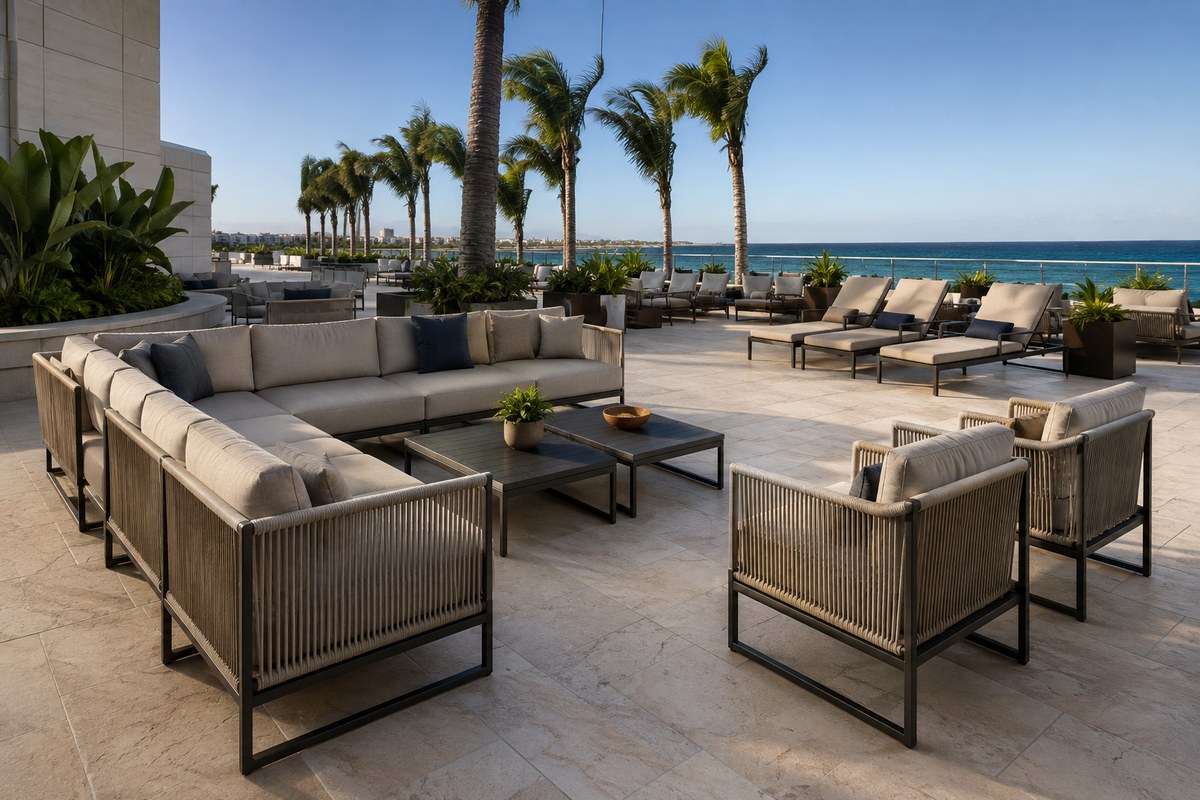
Modular outdoor furniture is best specified as a repeatable seating program for terraces, resorts, restaurants, villas, and distributors. Buyers should define service zones, module sizes, connector behavior, seat depth, frame finish, cushion fabric, weather exposure, cleaning routine, storage method, replacement parts, and reorder codes before approving a commercial order.
Key Takeaways
Modular outdoor furniture works well when each sofa, corner, chair, ottoman, and table has a clear module code.
Seat depth, arm clearance, table height, and circulation space should be tested before quantity decisions.
Connector design, glides, frame weight, and staff handling affect whether modules stay aligned in daily hospitality use.
Cushion fabric, foam, drying method, removable covers, and storage rules are central to long-term appearance.
Commercial buyers need replacement parts and reorder records so future terraces match the original program.
Table Of Contents
Plan modular furniture by service zone
Test ergonomics and connector behavior
Match frame, weave, and cushions to exposure
Build a cleaning, storage, and reorder system
Review buyer tables, mistakes, FAQ, and quote scope
What Modular Outdoor Furniture Means For Commercial Buyers
Modular outdoor furniture refers to outdoor seating and tables built from repeatable units that can be combined in different layouts. A program may include armless seats, corner seats, left-arm and right-arm modules, ottomans, lounge chairs, coffee tables, dining-height add-ons, connectors, glides, covers, and replacement cushions.
For outdoor_furniture buyers serving Europe and North America, modular does not simply mean movable. The modules should hold a consistent visual language while adapting to different terrace sizes, restaurant zones, resort cabanas, villa patios, and distributor showroom packages. That requires codes, drawings, and operational planning.
The strongest order starts from how the space will be used. A pool lounge, breakfast terrace, rooftop bar, villa balcony, and restaurant waiting area need different seat depth, table access, shade exposure, cushion rules, and cleaning routines.
Start With Service Zones Instead Of A Single Pretty Layout
Hospitality spaces need zones. A hotel terrace may need a conversation lounge near the bar, flexible seats near the pool, compact pairs on small balconies, and deeper sectionals in private cabanas. Ordering one layout for every space wastes floor area and creates awkward staff movement.
A modular plan should show circulation paths, umbrella bases, planter positions, door swings, fire routes, view lines, and service access. Guests should reach tables comfortably, and staff should clean around the furniture without dragging heavy frames across finished flooring every morning.
Distributors can use the same logic for product displays. A showroom should show how one module family becomes a small balcony set, a resort lounge, or a villa conversation area. That helps buyers understand the system and reduces confusion in repeat orders.
| Outdoor zone | Module package to consider | Commercial reason |
|---|---|---|
| Hotel bar terrace | Corner sofa, armless seats, low tables, and connectors | Creates group seating without blocking service paths |
| Pool deck cabana | Lounger modules, ottomans, side tables, and washable cushions | Supports wet towels, sunscreen residue, and frequent cleaning |
| Villa patio | Left-arm, right-arm, corner, and chair modules | Adapts one family to different terrace shapes |
| Restaurant waiting area | Compact seats, stable glides, and smaller tables | Keeps circulation clear during busy service |
| Distributor showroom | Core modules with visible codes and material samples | Makes the collection easy to reorder and explain |
Test Seat Depth, Arm Clearance, Connectors, And Table Reach
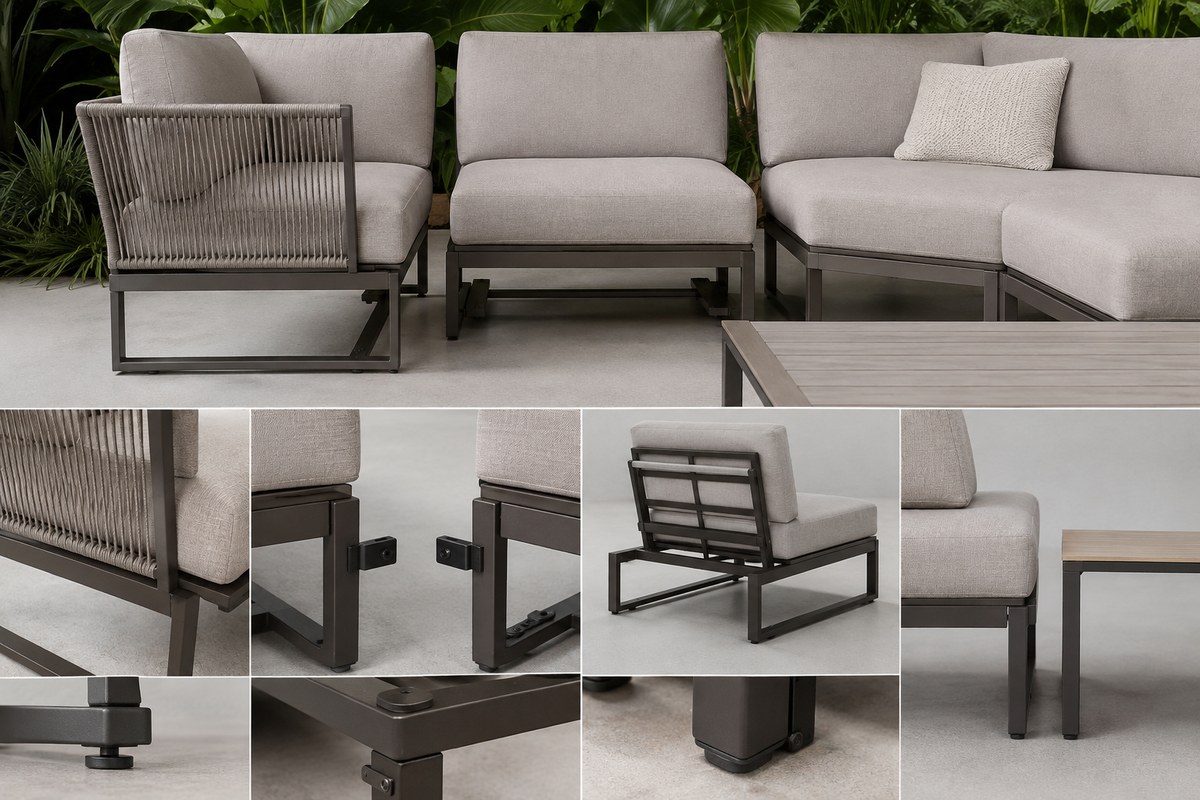
Comfort is measurable. Seat height, seat depth, back angle, arm height, cushion thickness, table height, and knee clearance should be checked with the intended use. A deep lounge module may feel premium for a resort cabana but inefficient for a restaurant terrace where guests need easier entry and exit.
Connectors affect daily orderliness. If modules drift apart whenever guests sit down, staff will spend time realigning furniture and cushions will wear unevenly. The buyer should ask how connectors engage, whether tools are required, and whether the connection can be serviced or replaced.
Floor glides deserve attention on stone, porcelain, concrete, timber decking, and composite decking. The glide material should protect the floor, reduce noise, and survive cleaning. A missing glide can make a premium furniture program look neglected quickly.
| Ergonomic or hardware check | Buyer question | Risk if ignored |
|---|---|---|
| Seat depth | Is the depth for dining support, lounge use, or cabana use? | Guests may sit awkwardly or avoid the seats |
| Arm clearance | Can guests enter from the side with cushions in place? | Modules may block natural movement |
| Connector style | Does it hold alignment under normal guest movement? | Staff must reset the layout repeatedly |
| Coffee table reach | Can guests reach drinks without leaning across cushions? | Tables become decorative instead of useful |
| Floor glide | Is the glide replaceable and suitable for the floor finish? | Noise, scratches, and wobble appear during service |
Match Frame, Rope, Weave, And Cushion Choices To Exposure
Weather exposure should guide material selection. Covered terraces, coastal pools, rooftop decks, shaded garden lounges, and restaurant street patios place different stress on frames, weaving, rope, fabric, foam, and fasteners. A supplier needs the exposure description before recommending a finish.
Powder-coated aluminum is common for commercial outdoor furniture because it balances weight and corrosion resistance, but coating quality, weld preparation, drainage holes, and fastener choice still matter. Rope and wicker surfaces need tension consistency and replaceable repair options when high-use zones wear faster.
Cushions are often the most visible maintenance issue. Fabric color, foam drying, seam construction, removable covers, zipper placement, and storage rules should be discussed before the order. A beautiful cushion that stays wet too long or stains easily will create operational complaints.
Create A Cleaning And Storage Routine Before The First Shipment
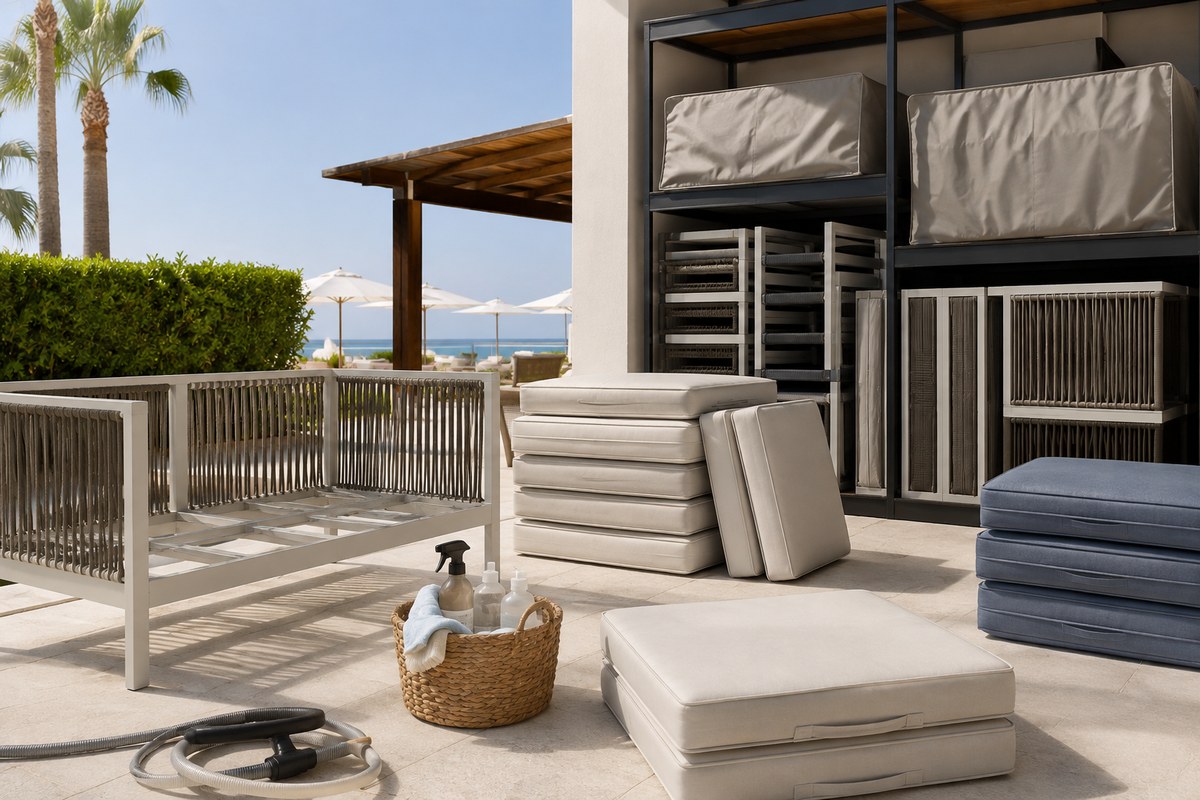
Modular outdoor furniture should come with a practical care plan. Staff need to know when cushions stay outside, when they move to storage, how covers are removed, what cleaners are allowed, and how frames are rinsed after dust, salt air, pollen, sunscreen, or food service.
Stacking and nesting are useful only when the furniture is designed for it. Some modules can stack; others can scratch, bend, or deform cushions if stacked carelessly. Buyers should ask which pieces can be stacked, how high, and whether protective pads or racks are needed.
Storage space should be measured like a service area, not guessed. A resort may have enough terrace area but too little cushion storage during storms or off-season closure. The procurement plan should include racks, covers, replacement cushions, and a labeling method that matches module codes.
| Operations item | Specification to request | Why it matters |
|---|---|---|
| Removable cushion covers | Fabric code, zipper position, washing limit, and spare-cover option | Supports cleaning without replacing full cushions |
| Frame cleaning | Approved cleaner, rinse method, and fastener check | Protects coating and reduces corrosion complaints |
| Storm storage | Which modules stack, nest, or need separate racks | Prevents damage during bad weather or closure |
| Replacement cushions | Seat, back, corner, ottoman, and lounge cushion codes | Makes partial renewal possible |
| Reorder continuity | Frame color, rope color, fabric code, connector code, and module list | Keeps later phases visually consistent |
Build Reorder Codes For Multi-Property And Distributor Programs
The business value of modular outdoor furniture is repeatability. A hotel group can use the same family in different properties with adjusted module counts. A distributor can stock core modules and quote project layouts quickly. Both cases need stable product codes and finish records.
A reorder file should include module drawings, frame finish, weave or rope color, fabric code, cushion dimensions, connector type, glide reference, table pairing, carton packing, and installed photos. That file lets a buyer add seats or replace visible parts without rebuilding the specification.
Batch changes should be managed openly. If fabric, coating, or weave color changes slightly in a later run, the supplier should help the buyer decide whether to mix old and new modules or separate them by zone. Clear records reduce disputes after delivery.
Mistakes That Hurt Modular Outdoor Furniture Programs
Ordering by lifestyle image without checking seat depth, table reach, and circulation width.
Ignoring connectors until modules separate during daily guest use.
Choosing cushions without storage, drying, cleaning, and spare-cover rules.
Using one module mix for every terrace even when service zones are different.
Failing to keep frame, fabric, connector, glide, and cushion codes for future reorders.
FAQ
How does modular outdoor furniture differ from fixed patio sets?
Modular outdoor furniture uses repeatable seats, corners, tables, and accessories that can be rearranged or reordered, while fixed patio sets usually keep one layout and fewer replacement options.
Why is modular outdoor furniture useful for hotels?
Modular outdoor furniture is useful for hotels because the same product family can adapt to bars, pool decks, cabanas, balconies, and lounges while keeping consistent style and reorder records.
Should modular outdoor furniture use connectors?
Modular outdoor furniture should use connectors when the layout needs stable alignment, because connectors reduce module movement during guest use and daily cleaning.
How should outdoor cushions be specified?
Outdoor cushions should be specified by fabric, foam, seam construction, cover removal method, drying behavior, storage routine, replacement code, and cleaning requirements.
What should buyers send for a modular outdoor furniture quote?
Buyers should send terrace dimensions, layout zones, desired module list, seat-depth target, frame and fabric preferences, exposure level, cleaning routine, replacement-part needs, quantity, and destination market.
Modular Outdoor Furniture Buying Notes For Resorts And Distributors
Resorts and distributors buy modular outdoor furniture for different reasons, but both need a repeatable system. Resorts need operational layouts that hold up through guest use, cleaning, storms, and seasonal storage. Distributors need a product family that can be displayed, explained, stocked, and reordered without rebuilding every quotation.
A commercial order should define core modules and optional modules separately. Core modules might include armless seats, corners, left arms, right arms, lounge chairs, ottomans, and tables. Optional modules might include high-back pieces, daybed sections, dining-height tables, side tables, covers, and replacement cushions.
The buyer should also decide how many visual finishes the program can support. Too many frame, rope, and cushion combinations complicate inventory and make reorders harder. A focused palette with clear codes often performs better for hospitality and wholesale programs.
| Buyer type | Main modular outdoor furniture concern | Specification tool |
|---|---|---|
| Resort procurement | Guest comfort, terrace zoning, and replacement cushions | Zone layout with module codes |
| Restaurant operator | Seat turnover, table reach, and staff cleaning paths | Compact layout and cleaning checklist |
| Villa developer | Consistent look across different patio sizes | Module family with left-right options |
| Distributor | Display clarity, stock planning, and reorder speed | Core SKU list with finish codes |
| Property maintenance | Glides, covers, connectors, and spare parts | After-sales parts record |
Receiving And Season-End Review For Modular Outdoor Furniture
Receiving should check more than carton count. Staff should confirm that each module, connector, cushion, cover, glide, and table matches the packing list. Because many modules look similar, labels should be checked before packaging is discarded or units are sent to different terraces.
A season-end review helps improve the next order. Buyers should record which zones had cushion fading, frame scratches, loose connectors, difficult cleaning, or guest comfort complaints. Photos linked to module codes are more useful than general feedback because the supplier can identify the exact part and finish.
Future reorders should build from that evidence. If one module performed badly under coastal exposure, the buyer can change frame finish, cushion color, or cleaning rules for the next phase. If a layout performed well, the same module mix can be repeated across new properties or distributor promotions.
Packing And Handling Rules For Modular Outdoor Furniture Shipments
Commercial furniture shipments need packing that respects module shape. Corner sofas, armless seats, lounge chairs, tables, ottomans, cushion sets, and covers should not be counted as interchangeable cartons. Each piece should be traceable to a module code so the receiving team can stage full terrace groups before unpacking everything.
Frame protection should prevent rubbing at powder-coated corners, rope panels, woven sides, and table edges. Cushion cartons should stay dry and separate from sharp metal parts. If the destination has phased installation, cartons may sit in storage before final placement, so breathable protection and clear grouping become more important.
Staff handling should be considered during product selection. A beautiful module that is too heavy or awkward for daily cleaning will create scratches and staff frustration. Buyers should ask the supplier about frame weight, grip points, stacking limits, nesting methods, and whether special carts or racks are recommended.
For distributors, packing affects resale as well as delivery. Clean cartons, protected sample pieces, and consistent module labels make it easier to receive stock, prepare showroom displays, and ship partial orders to dealers or project customers without losing part identity.
RFQ Review For Modular Outdoor Furniture Programs
A modular furniture RFQ should include more than a model photo and total quantity. Buyers should request a module list, frame finish, rope or weave color, fabric code, cushion construction, connector method, glide type, cover option, carton packing, replacement-part list, and reorder terms.
The quote should make module logic visible. If a terrace set includes left-arm seats, right-arm seats, corners, armless seats, ottomans, and tables, each item should have its own quantity. This prevents a supplier from quoting a similar-looking set that cannot reproduce the planned layout.
Hospitality buyers should ask how future additions will be handled. A property may want to expand a terrace after the first season, replace high-wear cushions, or add matching side tables. Reorder terms and finish-continuity notes should be discussed before the first shipment.
For distributors, the RFQ should identify stockable core modules and project-only modules. That distinction helps inventory planning and makes it easier to serve both small dealer orders and larger hotel projects from the same modular outdoor furniture family.
The buyer should ask whether the supplier can provide loading photos, carton dimensions, and replacement-part packing references. Modular outdoor furniture often ships as bulky but vulnerable pieces, so logistics planning affects landed cost, site storage, and after-sales service as much as the visual design.
Commercial buyers should also ask how samples are handled. A frame sample, fabric swatch, rope color, cushion section, or one trial module can prevent a large order from being based only on rendering images. The sample record should become part of the final reorder file.
This record helps the next purchasing round start from proven terrace performance, not from memory, screenshots, or disconnected catalog names.
It also gives sales teams a reliable way to quote matching additions when a hotel, dealer, or villa buyer expands the same outdoor area later.
Request A Modular Outdoor Furniture Quote With Zone Layouts
To request an outdoor_furniture quote for modular outdoor furniture, send project type, terrace or patio dimensions, zone sketches, module combinations, desired seat depth, table pairings, frame material, rope or weave preference, cushion fabric, exposure level, storage plan, cleaning routine, reorder expectations, quantity by area, and destination market. A supplier can then quote a program that stays useful after the first shipment.