

Kitchen Cabinets for Project Buyers: How to Specify, Source, and Compare Options
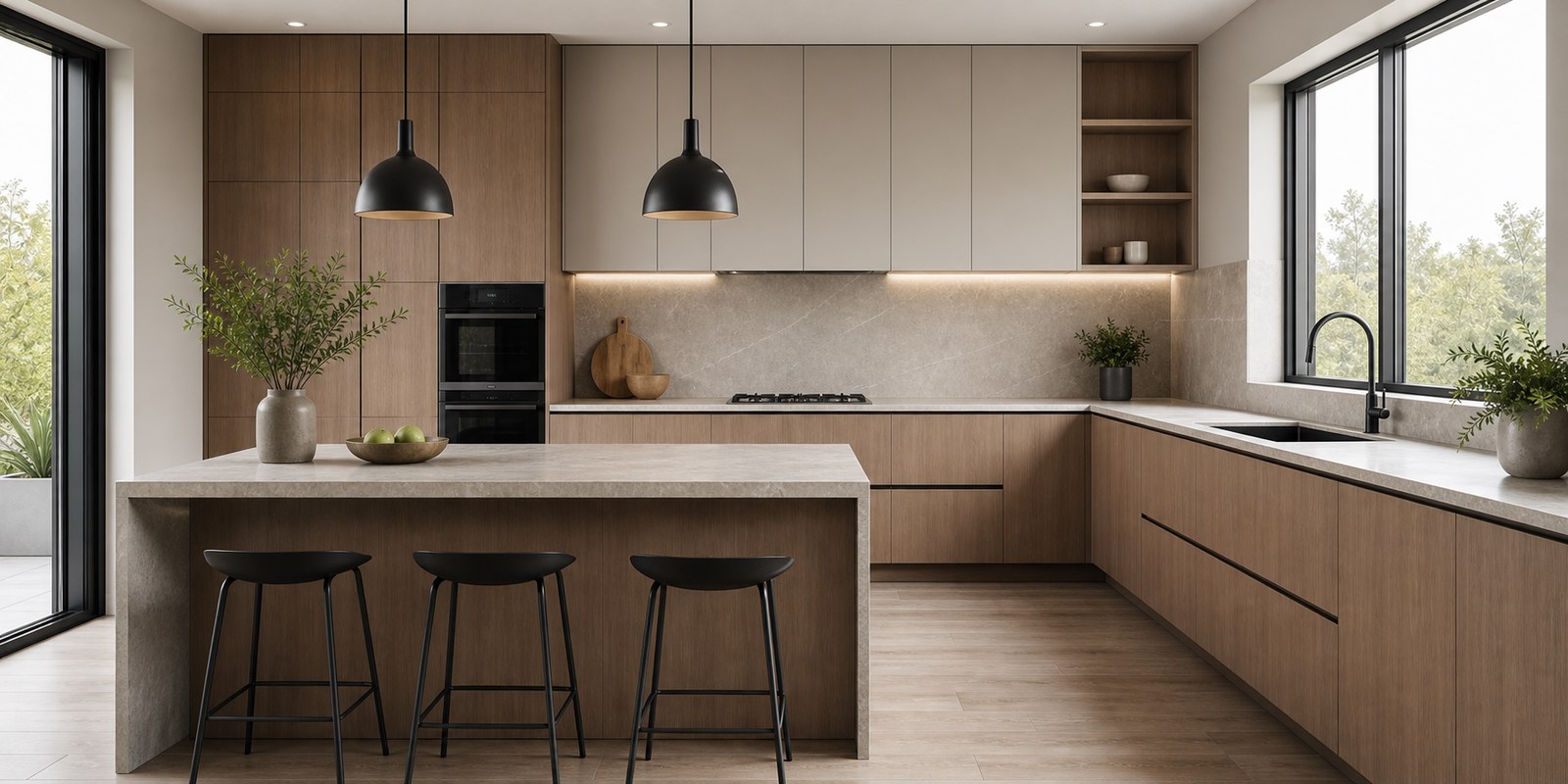
Kitchen cabinets are a core part of the interior package for apartments, villas, hotels, rental properties, and renovation programs. They shape the appearance of the kitchen, define storage capacity, support appliances, and influence how smoothly installation teams can complete the room. For project buyers, cabinets are not only a design item. They are also a coordinated manufacturing, packing, shipping, and installation system.
The keyword kitchen cabinets covers many buying situations. Some buyers are planning a single premium villa kitchen. Others need repeatable cabinet sets for hundreds of apartment units. Distributors may need a line that can be stocked, promoted, and reordered. Contractors may need a cabinet package that arrives with clear drawings and predictable hardware. This guide explains how to specify kitchen cabinets in a practical way and how to compare supplier proposals without relying only on catalog images or the lowest headline price.
Define the Cabinet Project Before Choosing a Style
Key considerations
A cabinet selection should begin with the project type. A high-end villa kitchen can justify more customization, premium finishes, and detailed accessories. A large apartment project may need controlled cost, fast installation, durable surfaces, and consistent dimensions across repeated unit types. A hotel or serviced apartment may need compact storage, easy cleaning, and replacement hardware that maintenance teams can handle quickly.
Buyers should prepare layout drawings, target quantity, appliance list, preferred style, required delivery schedule, destination, and whether installation support is needed. If several kitchen layouts are involved, each type should be listed separately. This allows the supplier to build a cabinet schedule, estimate quantities correctly, and identify layout risks before production.
Project clarity prevents the common mistake of selecting a cabinet style before understanding site conditions. Wall dimensions, ceiling height, appliance openings, plumbing points, electrical outlets, ventilation, and countertop requirements all influence the final cabinet system. A good supplier will ask for these details rather than quoting from a generic photo.
Confirm layouts, appliance openings, and cabinet quantities.
Compare cabinet box, door finish, hardware, and countertop scope.
Approve shop drawings before production.
Use clear carton labels for project installation.
Understand Cabinet Box Materials
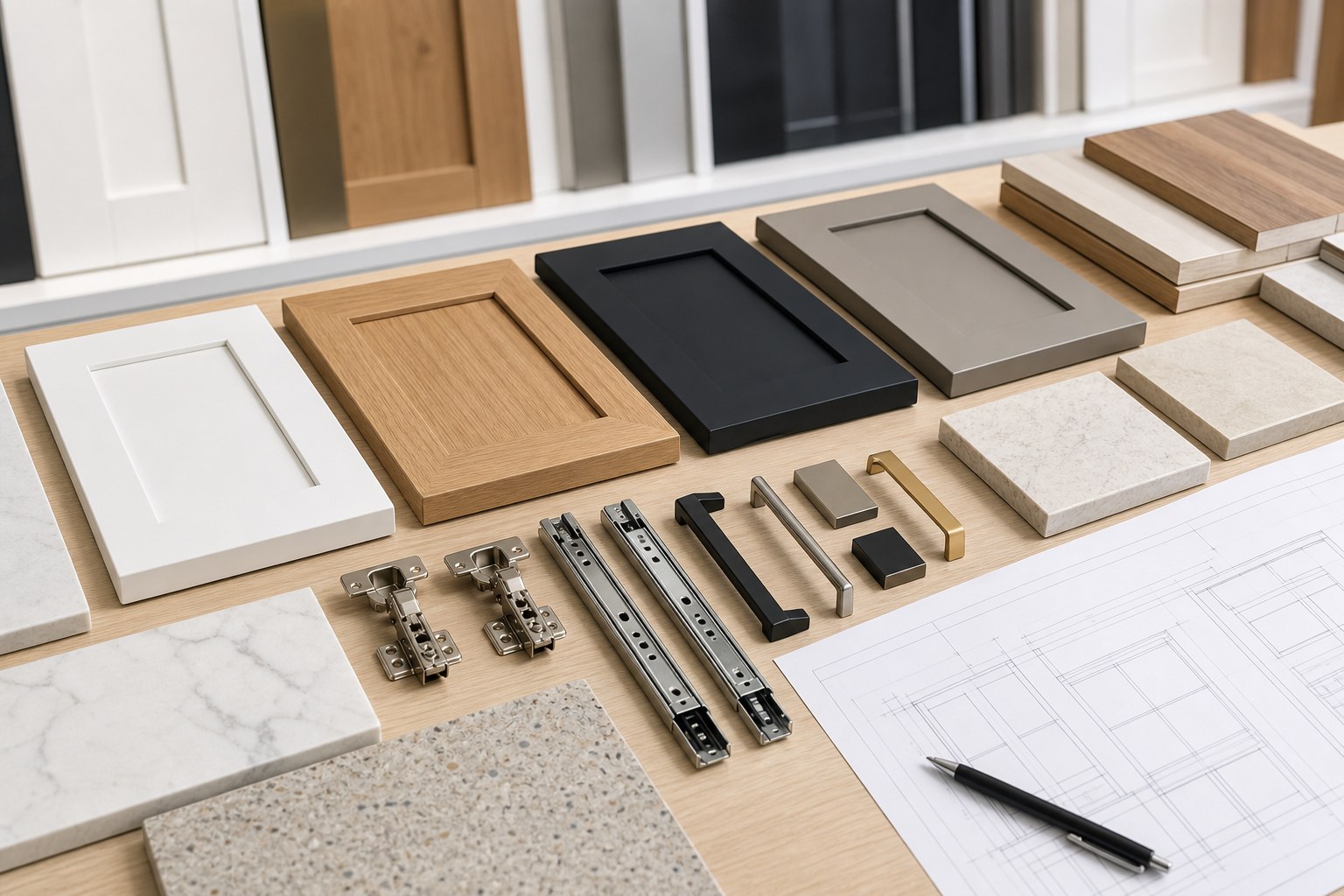
The cabinet box is the structural body of the cabinet. Common materials include plywood, MDF, particle board, and moisture-resistant engineered panels. Each material can be suitable when used in the right context, but buyers need to confirm the grade, thickness, surface finish, edge sealing, and intended application. A quotation that only says cabinet board is not specific enough for project comparison.
Plywood is often chosen when buyers want strength, screw-holding performance, and stable structure. MDF can provide a smooth substrate for painted surfaces and routed door styles. Particle board with melamine can be cost-effective for many standard cabinet boxes when the density and edge treatment are appropriate. Moisture-resistant panels may be useful in humid environments or projects where cleaning routines are more demanding.
Panel thickness should be stated for cabinet sides, shelves, backs, doors, and drawer components. Two cabinets may look similar from the outside while using different internal structures. For project buyers, those differences can affect durability, installation, and long-term maintenance.
Choose Door Finishes and Cabinet Styles
Key considerations
Cabinet doors and drawer fronts define the visual character of the kitchen. Flat-panel doors are common in modern apartments and minimalist villas. Shaker-style doors can support transitional and North American design preferences. Slab doors with matte finishes can feel clean and contemporary, while wood veneer introduces warmth and texture.
Popular finishes include painted MDF, melamine, laminate, PET, acrylic, wood veneer, and solid wood components. Each option has tradeoffs. Painted finishes offer broad color flexibility but need careful surface control. Laminate and melamine can be practical for high-volume projects. Wood veneer can elevate the appearance while maintaining an engineered structure. High-gloss finishes can look premium but may show fingerprints more easily.
Physical samples are essential. Buyers should review color, sheen, texture, edge treatment, and how the finish coordinates with flooring, countertops, tiles, and wall colors. If the cabinet will be used in many units, confirm that the selected finish can be produced consistently and replaced later if needed.
Review Hardware Before Approving a Quote
Hardware determines much of the daily user experience. Hinges, drawer slides, handles, lift-up systems, baskets, and organizers affect how the kitchen feels after installation. Weak hardware can make a cabinet seem cheap even when the finish looks good. Strong hardware can extend practical service life and reduce maintenance complaints.
Buyers should confirm hinge type, soft-close function, opening angle, drawer slide load capacity, slide extension, handle material, and any accessory brand or grade. For rental apartments and hospitality projects, easy replacement is often more important than adding many complex accessories. For premium villas, special pantry storage, corner solutions, and integrated lighting may be worth considering.
Do not assume hardware is included just because it appears in a rendering. The quotation should identify what is included, what is optional, and what may change the price. This is especially important when comparing proposals from different suppliers.
Coordinate Cabinets With Countertops and Appliances
Kitchen cabinets must coordinate with countertops, sinks, faucets, ovens, refrigerators, dishwashers, range hoods, and plumbing. Appliance openings should be based on confirmed models whenever possible. A few millimeters of misunderstanding can create installation problems, especially with built-in appliances or integrated panels.
Countertop scope should be clarified early. If the same supplier provides countertops, confirm material, thickness, edge profile, backsplash detail, sink cutout, faucet hole, and packing method. If countertops are supplied locally, the cabinet supplier should still provide dimensions and support details so the local fabricator can measure accurately.
Buyers should also plan filler panels, toe kicks, side panels, end panels, and ceiling gaps. These details are not glamorous, but they determine whether a kitchen looks complete. A well-designed cabinet package accounts for real construction tolerances rather than assuming every wall is perfectly square.
Use Shop Drawings and Approval Milestones
Key considerations
Shop drawings are the bridge between design intent and production. They should show cabinet dimensions, elevations, appliance positions, fillers, side panels, countertop references, and installation notes. For multi-unit projects, drawings should be organized by unit type so the buyer and site team can verify each kitchen correctly.
A clear approval process is critical. The supplier should know which version of the drawing is final, and the buyer should understand the deadline for changes. Once materials are ordered and production begins, revisions can affect cost, lead time, and schedule. Written approval protects both sides.
For large projects, consider a sample cabinet or mock-up kitchen before mass production. A mock-up helps confirm finish, proportions, drawer operation, storage capacity, countertop coordination, and installation details. It can reveal practical issues that are difficult to notice in drawings alone.
Confirm layouts, appliance openings, and cabinet quantities.
Compare cabinet box, door finish, hardware, and countertop scope.
Approve shop drawings before production.
Use clear carton labels for project installation.
Compare Kitchen Cabinet Quotations
Cabinet quotations can be difficult to compare because suppliers may price by linear meter, cabinet unit, kitchen set, or full project package. A low price is not useful unless the scope is clear. Buyers should ask for a written specification that identifies cabinet box material, door material, finish, hardware, accessories, countertop scope, packing, trade terms, and lead time.
A fair comparison separates required items from optional upgrades. Soft-close hardware, drawer boxes, handles, baskets, sink cabinets, tall cabinets, island panels, and countertop cutouts can all affect price. If one quotation includes these items and another excludes them, the totals are not comparable.
Total project value should include drawing support, quality control, packing, replacement policy, and communication reliability. A slightly higher cabinet price may be justified if it reduces installation problems, shipping damage, and after-sales confusion.
Plan Packing, Labeling, and Delivery

Key considerations
Kitchen cabinet projects involve many parts. Without clear packing and labeling, the site team may waste time sorting cartons and identifying missing pieces. For apartment projects, packages can be labeled by building, floor, room, unit type, or cabinet reference. The labeling system should match the packing list and shop drawings.
Flat-pack cabinets can reduce shipping volume and may be efficient when the local installation team is experienced. Assembled cabinets can reduce on-site assembly work but use more container space. The right choice depends on freight cost, labor cost, schedule, site storage, and installation capability.
Buyers should confirm protective packaging for doors, corners, hardware, countertop pieces, and fragile accessories. Good packaging does not make headlines, but it prevents avoidable cost. The best cabinet package is one that arrives organized, protected, and ready for the site team.
Confirm layouts, appliance openings, and cabinet quantities.
Compare cabinet box, door finish, hardware, and countertop scope.
Approve shop drawings before production.
Use clear carton labels for project installation.
Quality Control for Cabinet Orders
Quality control should be discussed before production. A supplier should check incoming materials, panel cutting, edge banding, drilling, finish quality, door alignment, drawer operation, hardware quantity, and packing accuracy. For overseas buyers, inspection photos and loading records can provide useful confirmation before shipment.
Dimensions should be checked against approved drawings. Finish samples should be compared against the approved reference. Hardware should be verified against the quotation. If countertops are included, cutouts and edge details should be checked carefully. These steps reduce the chance of discovering problems only after the shipment arrives.
Clear tolerances help avoid disputes. Cabinets are manufactured products installed into construction sites that may have their own variation. The buyer, supplier, and installer should understand what is acceptable and what requires correction.
How Project Buyers Can Reduce Risk
Risk reduction starts with documentation. Keep the approved quotation, material samples, drawings, finish codes, hardware specifications, packing list, and communication history together. This helps if the project repeats later or if replacement parts are needed.
The buyer should also nominate one person to approve drawings and changes. Multiple decision makers can slow the project and create conflicting instructions. The supplier should provide one clear contact for technical and commercial questions. This simple structure improves speed and accountability.
For recurring orders, standardize the successful specification. Once a cabinet box, finish, hardware package, and packing method are proven, future orders can move faster with fewer revisions. Standardization can still allow design variation through color, handles, and layout adjustments.
Conclusion
Kitchen cabinets should be sourced as a complete project system, not as isolated door colors. The buyer needs to evaluate structure, finish, hardware, drawings, countertops, packaging, logistics, and after-sales planning. A professional cabinet supplier should help turn the project brief into a buildable, deliverable package.
For developers, contractors, distributors, and design teams, the best cabinet decision balances design appeal with manufacturing practicality. When drawings, materials, and packing are controlled from the start, the final installation is more predictable and the finished kitchen feels more valuable to the end user.
If you are planning a kitchen cabinet project, prepare your layouts, quantities, target style, appliance information, destination, and schedule. Hansecabinet can review these details and help develop a suitable cabinet proposal for residential or commercial projects.
Project Buyer Checklist for Kitchen Cabinets
Before a cabinet order is approved, the buyer should confirm the commercial scope and the technical scope in the same review. The commercial scope includes quantity, delivery batch, payment terms, trade terms, validity period, and any service included in the price. The technical scope includes cabinet structure, door finish, hardware, countertop details, accessories, drawings, packing, and installation references. Keeping these two scopes together prevents a common problem: a price is approved before the project team understands what the price actually includes.
For multi-unit work, the buyer should create a cabinet schedule that lists each kitchen type, unit quantity, finish, countertop option, handle style, and appliance requirement. This schedule becomes the control document for quotation, drawing approval, production, packing, and delivery. If the schedule is not clear, the supplier may quote a general average that becomes inaccurate when the real layouts are separated later.
Buyers should also decide which details must be standardized and which can vary. Standard cabinet boxes, hardware, and internal construction can simplify manufacturing and replacement. Visible elements such as door color, handle style, countertop surface, and backsplash coordination can still create different design effects. This approach helps a project maintain visual range without losing production control.
Another useful step is to define the approval sample. A small door sample may confirm color, but it does not show cabinet structure, drawer operation, hinge adjustment, or countertop coordination. A larger sample set, or a mock-up cabinet for major projects, gives the buyer a more realistic basis for approval. The sample should be stored and referenced during inspection so both sides can compare production against the same standard.
Finally, buyers should confirm after-sales communication before shipment. Replacement panels, spare hinges, extra handles, and touch-up materials may be needed after installation or during property turnover. A supplier that prepares spare parts and records product codes can help the buyer resolve small issues quickly. This is especially important for developers and contractors who need to protect handover schedules and reduce maintenance friction.
For export buyers, it is also useful to define the handover package that should travel with the order. This may include final drawings, packing lists, carton labels, hardware lists, installation notes, care guidance, and inspection photos. These documents make it easier for a distributor, contractor, or site manager to receive the cabinets, assign them to the correct rooms, and answer questions from installers without waiting for a new round of communication across time zones.
Frequently Asked Questions About Kitchen Cabinets
What information is needed for a kitchen cabinet quote?
A supplier usually needs layouts, dimensions, quantity, preferred style, appliance information, countertop expectations, project location, and delivery schedule. For multi-unit projects, provide each kitchen type separately.
Are custom kitchen cabinets suitable for apartment projects?
Yes, but customization should be controlled. Repeated layouts, standard finishes, and clear drawings help keep the project efficient while still matching the design intent.
Which cabinet material is best?
There is no single best material for every project. Plywood, MDF, particle board, and moisture-resistant panels can all be suitable depending on budget, finish, environment, and performance expectations.
Should cabinets be shipped flat-pack or assembled?
Flat-pack cabinets can save shipping space, while assembled cabinets can reduce some site assembly work. The right option depends on freight, labor, storage, and installer capability.